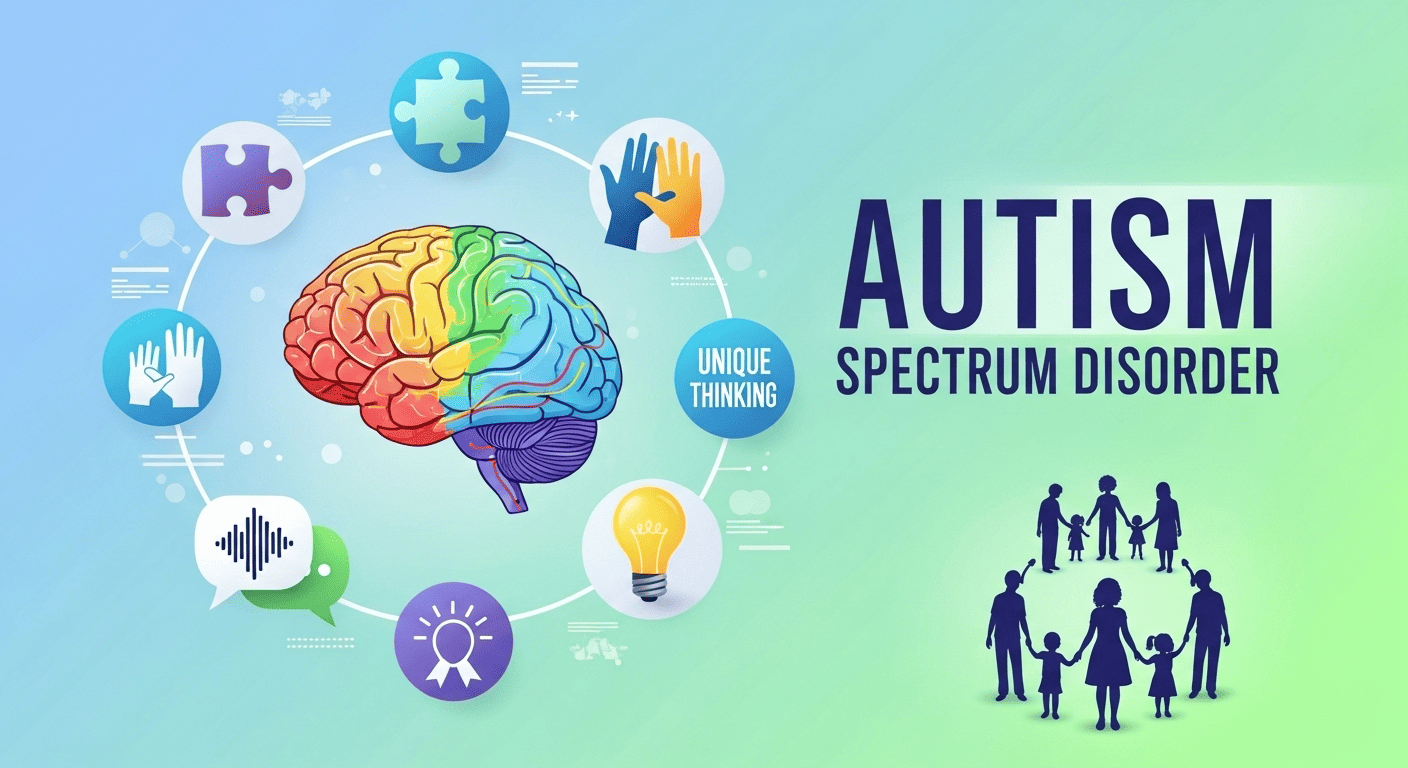

Autism Spectrum Disorder (ASD) is a condition based on Mental Health disorder. It has effects on a person that how he thinks, feels, speaks and connects with other persons. People with Autism Spectrum Disorder may behave, talk and learn in different ways that feel different from other persons.
It’s called a “spectrum” because each person has unique and different thoughts. Some people need lots of help and support and others need very little and little.
Children with autism may:
- Avoid eye contact
- Repeat words or actions
- Struggle with change
- Focus on one thing for a long time
- Find it hard to make friends
Adults may face other challenges. But autism does not mean someone is broken. It just means they think in another way.
Definition of Autism Spectrum Disorder
Autism Spectrum Disorder(ASD) means:
- A person has differences in brain development
- These differences affect social skills and behavior
- The signs appear early in life (often before age 3)
- It lasts a lifetime
Some people may speak well. Others may not speak at all. Some may have a strong focus. Others may struggle with loud sounds or bright lights. This is the reason why autism looks more different in every person.
Level 1 Autism Spectrum Disorder
Level 1 is the mildest and most simple form of autism spectrum disorder(ASD). People at this level can speak, learn and live on their own. But they still need someone’s help and support.
Signs of Level 1 ASD:
- Trouble making friends
- Talking in a one-sided way
- Struggles with change
- Needs clear rules and routines
- Might feel anxious in new places
- May seem “quirky” to others
They don’t need much support. But small changes in life can feel hard. Support helps them grow stronger.
OCD and Autism Spectrum Disorders
Some people with autism also have Obsessive Compulsive Disorder. Both can look the same, but they are not the same.
OCD signs:
- Thoughts that repeat over and over
- Need to do things in a certain way
- Fear something bad will happen if they don’t
Autism signs that seem like OCD:
- Repeating words or movements
- Needing routines
- Focusing on only one thing for a long time period
The key difference:
OCD causes fear. People with False Memory OCD don’t want the thoughts.
In autism, the behaviors are calming or feel normal.
Doctors must look closely to tell the difference.
Profound Autism Spectrum Disorder
Profound autism means a person needs full-time care. It is the most serious form of ASD.
Signs of profound autism:
- No spoken words
- Cannot take care of basic needs
- Very sensitive to light, sound, or touch
- May show strong behaviors like hitting or yelling
- Needs help with eating, dressing, and safety
These individuals often live with family or in special homes. They need full support for life. But with love and care, they can live good lives.
Autism Spectrum Disorder Foundation
Many groups work to support people with autism. These are called autism foundations.
What do they do?
- Help families understand ASD
- Train teachers and doctors
- Offer therapy or school programs
- Share books, guides, and videos
- Support jobs for adults with autism
- Raise money for research
These groups play a big role in awareness and care. Families should look and support local autism foundations for help and guidance.
Causes of Autism Spectrum Disorder
No one knows the main cause of autism. But scientists have found many factors.
Possible causes include:
- Genes passed down from parents
- Changes in brain development
- Being born early (premature birth)
- Low birth weight
- Older parents
- Other medical issues at birth
Autism is not caused by bad parenting, cell phones, or vaccines. These are false ideas. The truth is: autism begins before birth. And every person with autism is different.
Early Intervention for Autism Spectrum Disorders
Helping children early makes a big difference. This is called early intervention.
What helps in early years:
- Speech therapy
- Behavior support
- Social skills groups
- Occupational therapy
- Family training
Why early help works:
- The brain grows fast before age 5
- Learning is easier at young age
- It builds skills that last a lifetime
If a parent has signs of autism, they should ask a doctor. The immediate help starts the better the outcome.
Autism Spectrum Disorder Definition
To define autism spectrum disorder again in simple words:
- It is a lifelong brain condition
- It changes how a person talks, plays, and understands others
- It can be simple, medium and can be profound.
- It affects the people of every race, gender and background
It is not something you “catch” or “get over.” But people with Autism Spectrum Disorder can grow with the right support and help.
Autism Spectrum Disorder in Adults
Many adults live with autism. Some were diagnosed as children. Others learn about it later in life.
Signs of autism in adults:
- Struggles with small talk
- Feels tired after social time
- Likes routines and deep focus
- May have one or two deep interests
- Has strong sense of right and wrong
- Feels out of place in groups
Some adults with ASD do not need help. Others do. Jobs, housing, and health care should match their needs. Support groups for adults also help.
Autism Spectrum Disorder Level 1
Let’s look again at autism spectrum disorder level 1 using bullet points:
- Talks clearly, but may miss social cues
- May interrupt or speak too much about one topic
- Doesn’t enjoy group games or small talk
- Gets upset when plans change
- Needs clear rules and quiet spaces
- Can work or study with some support
- May have trouble making or keeping friends
Early help with social thinking and stress control is important for Level 1 autism.
Autism Spectrum Disorder PDD-NOS
Before the word “spectrum” was used, doctors said PDD-NOS. It stood for “Pervasive Developmental Disorder – Not Otherwise Specified.”
What it meant:
- A child showed some signs of autism
- But not enough for a full diagnosis
- The child still needed help with learning and behavior
Now, all these types are called Autism Spectrum Disorder. The term PDD-NOS is no longer used by most doctors. But it still appears in old papers and school files.
Different Kinds of Autism-Spectrum Disorder
Autism looks different in every person. There are many kinds or “types” within the spectrum.
Here are a few:
- Classic autism: clear signs, more support needed
- Level 1 autism: mild signs, low support needed
- Profound autism: major needs, full support
- Asperger’s syndrome: now called level 1; high language, but social struggles
- PDD-NOS: older name, now part of ASD
- Nonverbal autism: no spoken words, uses signs or devices
- Autism with high intelligence: may do well in school but need social help
Each person has their own mix of strengths and needs. That’s why it’s called a spectrum.
Does Autism Spectrum Disorder Get Worse with Age
Many parents ask this. The answer is no — autism does not get worse over time. But it can feel harder at some stages.
What can happen as a person grows:
- School rules get harder to follow
- Jobs need social skills
- Change becomes more common
- Stress and anxiety may grow
But with help:
- Social skills improve
- Coping skills grow
- People find jobs that match their strengths
- Many live happy and full lives
So, autism itself doesn’t “get worse.” The world just becomes more complex. That’s why support matters.
FAQs
Q1. Can autism be cured?
No. It can’t be cured. Autism is not an illness. But support helps people live better lives.
Q2. Can people with autism go to school or work?
Yes! Many children go to regular school. Many adults have jobs. They may just need support.
Q3. What if my child doesn’t talk yet?
Some children talk later. Some use pictures or devices. All can learn to communicate.
Q4. Can girls have autism?
Yes. Girls may show different signs. They may copy others or hide their struggles.
Q5. Do all people with autism have high intelligence?
No. Some do. Some don’t. Thinking levels are not the same for everyone.
Q6. What should I do if my child has autism?
Talk to your doctor immediately. Get a full mental check-up. Early help is best.
Final Thoughts
Autism Spectrum Disorder(ASD) is not a critical problem for Mental Health. It is just a different way of thinking. People with autism can lead strong, happy lives, with lots of love and care.
Also Read : Major Depressive Disorder & Stimulant Use Disorder